In the last posting here we made a chicken, brined it, roasted it, consumed it, fed it to ours rats or other various pets and then we got yelled at by the wife or husband for leaving carrot shavings in the sink overnight and cooking to much fatty food. There were also bones, anywhere from 2-3 whole pounds of bones depending on the size of the bird and what I didn't feed to my pet rats I saved to make one of the most basic components of cooking, stock. Good stock beats the pants off of anything that you can buy at the store. Not only does it lend a nice aroma to your house during the 4-5 hour process of making it, but it is the foundation of so many dishes from risotto to sauces to soups. Today I'm going to run you through a fairly basic stock with a little help from Michael Ruhlman's Ratio.
As you can see by the title of the book we are going to use a ratio here to make our stock, 3-2. Simply, it is 3 parts water to 2 parts bone. I had 2 pounds of chicken bones left, so I used 3 pounds of water (6 cups) to produce it. The rest of the ingredients were as follows:
Almost done, 1 more hour.
1/2 pound onion (I used 1/4 pd. leeks & 1/4 pd. onions)
1/4 pound celery
1/4 pound carrot
4 cloves of garlic
1 bay leaf
1 tsp. of black peppercorns (crushed of course, you can also roast them a bit first)
3 sprigs or so of thyme
small bundle of parsley
Once you have your chicken bones and COLD water in the pot bring you temperature up to just below a simmer (180 F) then drop the temp to low, skim the congealed junk (proteins and foam) off the top, and let that baby sit for 4 hours or so. During the last hour of cooking add the remaining ingredients listed above to finish the stock. Additions will cool the stock so, bring back to a simmer then reduce the heat to low again and give it another 45-60 minutes to steep.
Not just for hair or hippies.
Finally, remove the large pieces of bone and discard, run the stock through a fine mesh strainer or chinoise then repeat the process again through some cheese cloth. For some bizarre reason I can not find cheesecloth in Lincoln, NE so, I just use a bandanna that I stole from my wife, she wasn't happy but it works just fine and I can simply wash it. Throw the freshly strained stock in the fridge to cool and store. It will keep for 7 days in the fridge and a month or so in the freezer. Be careful not to keep around onions or other things that will impart odors on the stock because it will pick them up.
There ya have it, either store in a ziplock bag or nice sealable tupperware and you have yourself roughly 4 cups of chicken stock to use on whatever your heart desires. My wife used it immediately after I made it for some mad wive's breakfast risotto. Till next time.
Chicken, that versatile, oft genetically enhanced fowl, rotting away in cramped quarters before they are strapped down, electrocuted then beheaded. Mmmmm. Sorry for the visual, but it is the reality of our mass produced food system in this country. Cruelty and absurdness aside it is the protein that seems to find its way onto American dinner plates more often than not. I love it, not the process it took to get to my kitchen, but the fact that it is something of a tabula rasa of the protein world. It can be prepared an ungodly amount of ways, with pretty much any flavor combination that our little minds can dream up. Escoffier, I believe it was him, went as far as saying that the stock derived, be it chicken, veggie, etc. is the canvas from which a chef works upon to layer and build, yadda yadda yadda. So, without further ado I direct you to Michael Ruhlman's simple lemon-herb brine and a little tutorial on how I go about cooking my birds, with a little help from a few links and a video or two.
First the brine:
Lemon/Herb Brine Components
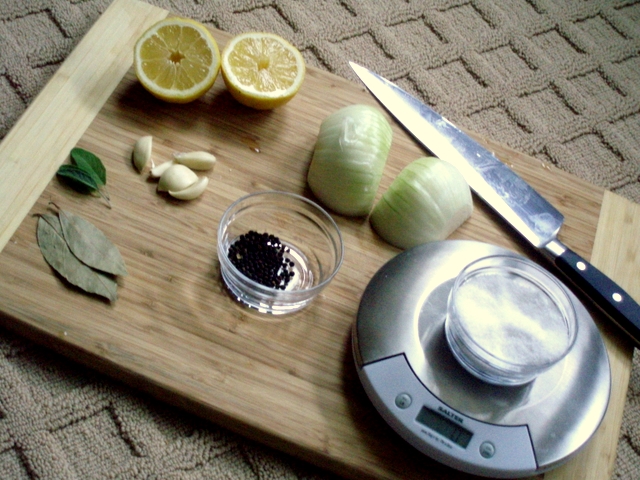
Not many things taste better than a chicken that has soaked in a brine for 8-12 hours, nor are many things that moist. It works great for roasting the bird, and it is even better for frying the bird due to the abbreviated cooking time involved. Speaking of abbreviated times, I got the urge to roast myself a bird last evening at about 5 o.m. and realized that I would have to speed this process up a bit. If you go over to Michael Ruhlman's blog, he has a great article on shortening the brining time by amping up the salt/water ratio to about a 10% salt ratio, which is normally about a 5% salt concentration. In short, you are using 100 grams of salt to 1000 grams (1 liter) of water. For those that don't use the metric system your measuring cup has liters on it, and you really really really need to invest in a scale. I use this low-end Salter model and it works just fine. In addition you can get some more info on basic brining concentrations, ratios, and tips from Cook's Illustrated here.
If you wouldn't hurt me I would drink you.
Due to my inability to understand copyright issues I'm not going to repost the recipe for the brine here, but you can see the components above here and gather what you might need (Just go to Ruhlman's blog) That pretty fresh green leaf is sage, but you could substitute thyme, rosemary, tarragon, marjoram, or whatever your heart desires. Sage is just my favorite with chicken. What you do is add all of those above ingredients into a pot with 500g (1/2 liter) and bring it to a boil, once boiling remove from heat and cover for 10 minutes. After 10 minutes you will pour the mixture over 500g of ice (Your scale comes in handy here) to cool the mix quickly to a usable temperature. Once all of the ice is melted you can stick your chicken in a seal-able bag and let rest at room temperature for 2-3 hours. When you hit the 2-3 hour mark, pull your chicken out, discard your remnants and pat the chicken dry and let the chicken sit for another hour at room temperature to let the salt and juices redistribute themselves evenly through the bird. Next, trussing...
There are many ways to truss a bird and you may already know how, but after some searching on variations I came across Brian Polcyn's method, which instantly became my favorite for its simplicity, yet ability to really tighten everything up nicely. He even has a nice video, left, to walk you right through it. So you've watched the video and you understand the trussing concept, let's hold off on tying her/him up and figure out how we can dress this bird up for success while it cooks.
Sorry for the ugly photo.
My roasting pan became the victim of one to many bizarre broiling attempts so I had to use a makeshift one yesterday, but it worked fine. You can either use a metal rack or a natural base to raise the bird from the pan. The reason we do this is to allow proper air circulation, which helps us in even cooking. For the natural base I use a rough large chop mirepoix (celery, carrots, onions) to add some aromatics to the party. While we are chopping up our base we should also make a small rough chop mirepoix to use to stuff the bird with as well. In addition to the veggies you can give it a nice shower of Kosher Salt and cracked black pepper (about a tablespoon of each). I added a bit more because my wife can't stand the skin and I love mine over-salted. Last night I also had some compound butter with roasted garlic in it that I rubbed between the skin and the meat. It is pretty simple to do such, just run your hand between the skin and the meat, carefully separating it and watching not to tear. One of the pitfalls of doing this is the butter will create steam, which is something you do not want when roasting the bird. Since I don't advocate putting any liquid in the bottom of the pan the effects seem to be negligible, and I haven't had much problem losing moisture in the finished product.
Ooo blurry bird you will get a new camera soon.
To cook, crank your oven up to 450 degrees F and when ready, stick her/him in. Now, I'm sure that you've seen recipes that say cook the bird at 375 degrees F, but this is just too low. You want heat here and the slow cooking will dry you out. Make sure you have your trusty thermometer on hand and take the time to check your temps in the thickest part of the the thigh, taking care not to hit any bones with the probe. When you have reached 175 degrees F pull the bird and let it sit for 15 minutes to redistribute the juices evenly throughout as well as carry over the cooking. Carve, enjoy, unbuckle your belt then sit on the couch with your hands in your pants, you deserve a rest.